Stability
Aircraft Design Characteristics
Each aircraft handles somewhat differently because each resists or responds to control pressures in its own way. For example, a training aircraft is quick to respond to control applications, while a transport aircraft feels heavy on the controls and responds to control pressures more slowly. These features can be designed into an aircraft to facilitate the particular purpose of the aircraft by considering certain stability and maneuvering requirements.
Stability
Stability is the inherent quality of an aircraft to correct for conditions that may disturb its equilibrium and to return to or continue on the original flight path. The two types of stability are static and dynamic.
Static Stability
Static stability refers to the initial tendency, or direction of movement, back to equilibrium. In aviation, it refers to the aircraft’s initial response when disturbed from a given pitch, yaw, or bank.
- Positive static stability: the initial tendency of the aircraft to return to the original state of equilibrium after being disturbed.
- Neutral static stability: the initial tendency of the aircraft to remain in a new condition after its equilibrium has been disturbed.
- Negative static stability: the initial tendency of the aircraft to continue away from the original state of equilibrium after being disturbed.
Dynamic Stability
Dynamic stability refers to the aircraft response over time when disturbed from a given pitch, yaw, or bank.
- Positive dynamic stability: the over time response of the aircraft to return to the original state of equilibrium after being disturbed.
- Neutral dynamic stability: the over time response of the aircraft to remain in a new condition after its equilibrium has been disturbed.
- Negative dynamic stability: the over time response of the aircraft to continue away from the original state of equilibrium after being disturbed.

Stability in an aircraft affects two areas significantly:
- Maneuverability
An aircraft’s maneuverability is determined by its ability to:
- Change ATTITUDE around the aircraft’s three axes (longitudinal, lateral, and vertical).
- Change VELOCITY on the aircraft’s three axes, and in the three spatial dimensions (1 vertical and 2 horizontal).
- Controllability
Controllability is the capability of an aircraft to respond to the pilot’s control, especially with regard to flight path and attitude. It is the quality of the aircraft’s response to the pilot’s control application when maneuvering the aircraft, regardless of its stability characteristics.
Longitudinal Stability (Pitching)
Definition:
Longitudinal stability, or pitch stability, refers to an aircraft's stability about its lateral axis (wingtip to wingtip), controlling the nose-up and nose-down motion.
Importance:
A longitudinally unstable aircraft may dive or climb excessively, potentially leading to dangerous flight conditions.
Key Factors Influencing Longitudinal Stability:
- Wing Location Relative to CG:
- The position of the wing affects the aircraft's balance and stability. The center of gravity (CG) must be correctly positioned relative to the wing for stable flight.
- Horizontal Tail Surfaces Location Relative to CG:
- The horizontal stabilizer's placement is crucial for pitch control. It provides a balancing force to counteract pitching moments.
- Tail Surface Area:
- The size of the tail surfaces (horizontal stabilizer) determines the effectiveness of pitch control. Larger surfaces provide more stabilizing force.
Demonstration of Longitudinal Stability:
- Trim the aircraft for level, hands-off flight.
- Push the controls slightly to nose down the aircraft.
- Observe the aircraft's response:
- Positive Stability: The nose returns to the original position with diminishing oscillations.
- Neutral Stability: The nose returns, but oscillations continue without damping.
- Negative Stability: Oscillations increase, indicating instability.
Lateral Stability (Rolling)
Definition:
Lateral stability refers to the stability of an aircraft about its longitudinal axis (nose to tail), helping to stabilize rolling movements.
Key Design Factors:
- Dihedral:
- Definition: The upward angle of the wings from the roots to the tips.
- Function: In a sideslip, the lower wing experiences an increased angle of attack (AOA), generating more lift, which raises it and stabilizes the roll.

- Sweepback and Wing Location:
- Sweepback: Wings with a backward sloping leading edge. When one wing drops, it becomes more perpendicular to the airflow, generating more lift and rising back to level.
- Wing Location: High-wing or low-wing configurations affect stability. High wings enhance lateral stability through the keel effect.

- Keel Effect and Weight Distribution:
- Keel Effect: High-wing aircraft naturally align with the relative wind due to the fuselage acting like a keel.
- Weight Distribution: The weight of the fuselage acts like a pendulum, returning the aircraft to level flight when disturbed.
Directional Stability (Yawing)
Definition and Importance:
- Directional stability refers to the stability of an aircraft about its vertical axis, known as yawing stability.
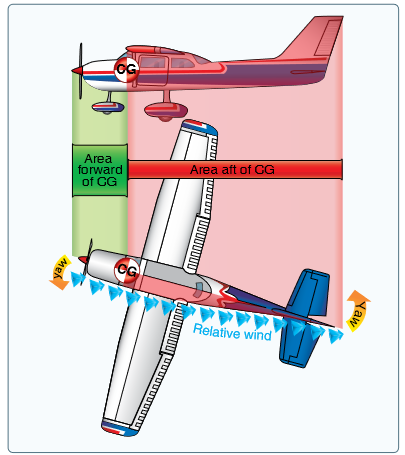
- It ensures the aircraft naturally points its nose into the relative wind, much like a weather vane.
Design Considerations:
- Vertical Fin: The primary contributor to directional stability is the vertical fin at the tail of the aircraft. This fin functions like the feather on an arrow, keeping the aircraft pointed correctly.
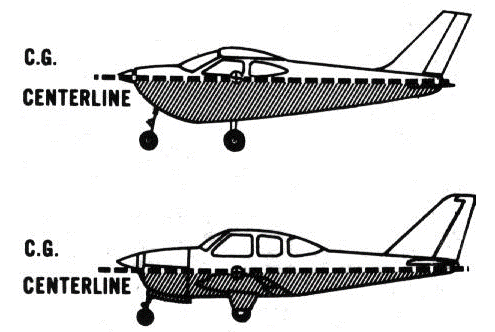
- Fuselage Area Aft of CG: The sides of the fuselage behind the center of gravity (CG) also contribute to stability. These areas help align the aircraft with the airflow.
Weather Vane Analogy:
- A weather vane balances its surface area around its pivot. To ensure it points into the wind, it must have more surface area behind the pivot point than in front.
- Similarly, an aircraft must have a greater surface area behind the CG to maintain directional stability.
Enhancing Stability:
- Position and Size of the Fin: The farther aft and the larger the vertical fin, the greater the directional stability. This helps the aircraft maintain straight flight by counteracting any yawing motions effectively.